
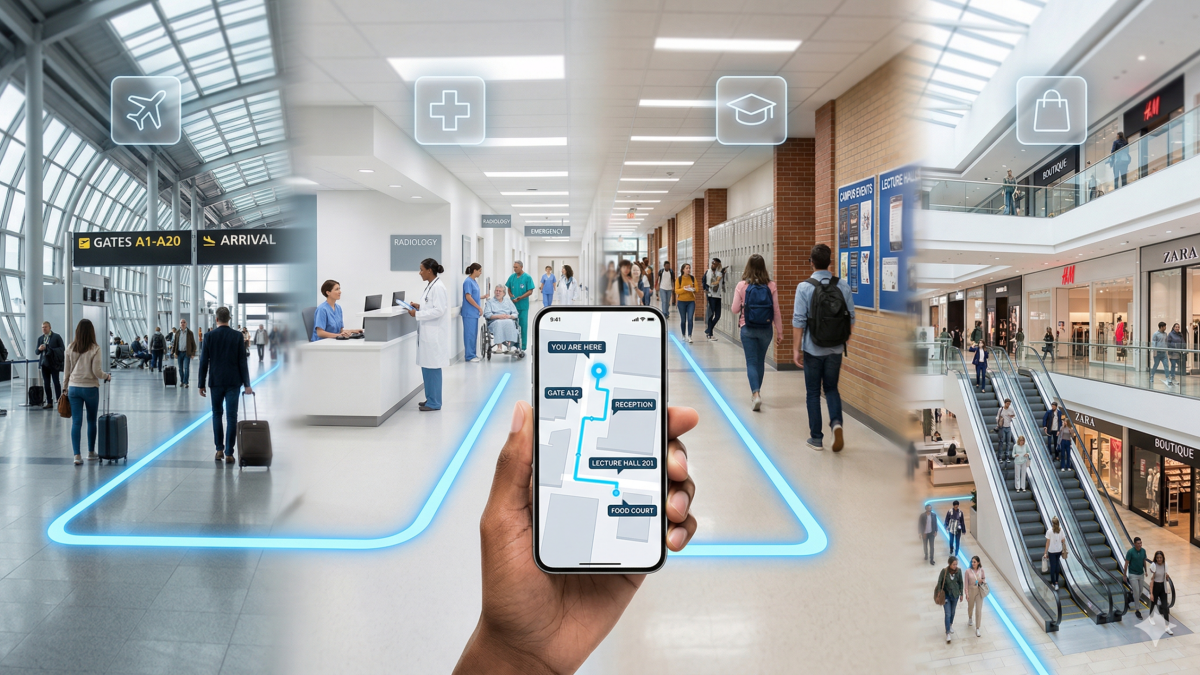
Most people can navigate to any building on earth in seconds using GPS. But the moment they walk through the front door, they’re on their own — and 53% of them get lost.
That gap between outdoor GPS and indoor navigation is one of the most expensive experience failures in modern buildings. Indoor maps exist to close it. And in 2026, they’ve moved from a novelty to a necessity.
This guide explains what indoor maps are, how indoor navigation technology works, why it matters for different venues, and the best practices that separate effective digital wayfinding from wasted investment.
What Is an Indoor Map?
Q: What is an indoor map and how does it work? A: An indoor map is a digital, interactive representation of a building’s interior — including floors, rooms, corridors, elevators, and points of interest — that allows visitors to search for destinations and receive turn-by-turn navigation directions indoors, where GPS doesn’t work. Indoor maps use technologies like Bluetooth Low Energy (BLE) beacons, Wi-Fi positioning, or Ultra-Wideband (UWB) to determine a visitor’s real-time location inside the building.
Unlike static paper directories or fixed signage, indoor maps are dynamic. They update in real time, support multiple languages, provide accessible routing for wheelchair users, and deliver data back to venue operators on how visitors move through the space.
Why Do Buildings Need Indoor Maps in 2026?
Q: Why are indoor maps important for large venues? A: Because 53% of venue visitors experience navigation problems, 77% already use digital tools to find their way, and only 23% still rely on physical signage. For airports, hospitals, universities, and malls, poor indoor navigation directly increases visitor stress, reduces dwell time, lowers satisfaction scores, and costs revenue.
These numbers come from Mappedin’s 2026 State of Venue Experience report, which surveyed nearly 500 venue visitors across North America. The findings confirmed that digital wayfinding adoption now spans every age group from 18 to 60+ — this isn’t a generational preference. It’s a baseline expectation.
For venue operators, the business case is straightforward: every minute a visitor spends lost is a minute they’re not shopping, dining, attending appointments, or engaging with the space.
How Does Indoor Navigation Technology Work?
Indoor maps combine three technology layers to guide visitors inside buildings where GPS signals can’t reach.
Q: How does indoor positioning work without GPS? A: Indoor positioning uses local wireless technologies — BLE beacons, Wi-Fi access points, or UWB sensors — installed inside buildings to determine a visitor’s location. The visitor’s smartphone detects these signals, and the indoor map platform calculates their position and displays it as a “blue dot” on the digital floor plan, similar to the blue dot in outdoor navigation apps.
The map layer is a detailed digital floor plan converted from CAD or BIM architectural files. It represents every floor, corridor, staircase, elevator, restroom, and point of interest. The best implementations are interactive — visitors can pan, zoom, rotate, and switch between floors.
The positioning layer determines where the visitor is inside the building using BLE, Wi-Fi, or UWB signals. BLE beacons are the most common choice for their low cost and scalability. UWB provides centimeter-level accuracy for environments that need precision, like hospitals tracking equipment.
The routing layer calculates the shortest or most accessible path from the visitor’s current location to their searched destination, delivering step-by-step directions that account for elevators, stairs, restricted zones, and wheelchair-accessible routes.
What Are the Benefits of Indoor Maps for Visitors?
Q: What are the main benefits of digital indoor maps for visitors? A: Indoor maps reduce navigation time, lower visitor stress and anxiety, support multilingual and accessible wayfinding, enable discovery of amenities and services, and eliminate dependence on staff for directions. Studies show 87% of users reported reduced navigation time and 94% preferred digital wayfinding over traditional signage.
Those results come from a peer-reviewed ScienceDirect study on IoT-based hospital wayfinding, where 100% of surveyed users said they would recommend the digital system to others. The psychological benefit is significant — 83% of users reported reduced stress from navigation, which matters enormously in high-anxiety environments like hospitals and airports.
For venue operators, the benefits mirror the visitor side: fewer repetitive directional queries for staff, higher retail and F&B engagement, improved satisfaction metrics, and actionable data on how visitors actually use the space.
Best Practices for Indoor Maps in Airports
Q: How do airports use indoor maps to improve passenger experience? A: Airports deploy indoor maps through QR codes at terminal touchpoints — arrivals, security exits, gate areas, and parking — giving passengers instant browser-based navigation without app downloads. Leading airports integrate wayfinding with flight information systems so passengers can search by flight number and get routed directly to their gate.
Effective airport wayfinding also connects navigation to retail and dining discovery. Mappedin’s research shows 50% of venue visits are discovery-oriented — passengers will browse and spend if they can easily see what’s nearby on their route. When a traveler sees a coffee shop is 90 seconds away and on the way to their gate, they’re far more likely to stop.
Additional airport best practices include providing accessible routing for passengers with reduced mobility, supporting multilingual navigation for international travelers, and integrating wayfinding with digital signage so screens display contextual directions based on location and time.
Best Practices for Indoor Maps in Hospitals
Q: How do hospitals use indoor maps to improve patient experience? A: Hospitals deploy indoor maps through SMS or QR-triggered navigation starting at check-in — sending patients a link with directions to their specific appointment room. This approach reduces the most common hospital navigation failures: visitors getting lost within ten minutes of arrival and 35% forgetting where they parked.
Hospital wayfinding requires special attention to emotional design. Visitors arrive under stress, and complex multi-building layouts compound anxiety. Best practices include enabling department-level search (“Cardiology,” “Lab,” “Emergency”) instead of room numbers alone, supporting multilingual navigation for diverse patient populations, and integrating parking lot wayfinding so visitors can find their car when leaving.
Connecting indoor maps to patient satisfaction metrics like HCAHPS scores makes the business case concrete — visitor navigation experience directly influences survey responses, hospital ratings, and reimbursement.
Best Practices for Indoor Maps on University Campuses
Q: How do universities use indoor maps to help students navigate campus? A: Universities deploy indoor maps through QR codes on orientation materials, building entrances, and campus posters — giving new students instant navigation on their first day without downloading an app. Research ranks “findability” as the number-one priority for campus users, ahead of advanced technologies like VR and robotics.
Campus wayfinding serves two distinct audiences. New visitors — prospective students, parents, and event attendees — need immediate orientation and building-level guidance. Daily users — students, faculty, and staff — need ongoing utility like real-time room availability, study space finders, and event location guidance.
Best practices include building a room-finder feature that shows live availability, integrating campus maps with academic calendars and event schedules, providing accessibility routing across outdoor paths and between buildings, and using the map platform as the foundation for smart campus initiatives like occupancy-based energy management and space utilization analytics.
Best Practices for Indoor Maps in Shopping Malls
Q: How do shopping malls use indoor maps to increase visitor engagement and revenue? A: Malls deploy indoor maps as discovery engines — not just directories. Beyond search and navigation, effective mall maps surface promotions, events, new store openings, and dining options within the map interface. This converts the 50% of visitors who arrive without a specific destination into active browsers and spenders.
Navigation friction has a direct revenue impact: every minute a shopper spends searching for a store is a minute they’re not browsing, eating, or making impulse purchases. PwC research indicates 78% of Gen Z and millennial mall visitors prefer digital wayfinding solutions over asking for directions or using static maps.
Mall best practices include deploying maps on both kiosks and mobile via QR codes, providing tenant-level search with open hours and category filters, integrating wayfinding with loyalty programs and promotional notifications, and feeding foot traffic analytics back to leasing teams to optimize tenant mix and layout decisions.
What Are the Universal Best Practices for Indoor Maps?
Regardless of venue type, five principles separate indoor maps that work from indoor maps that get ignored.
Q: What makes a good indoor map solution? A: The best indoor map solutions share five characteristics: zero-friction access (QR-to-browser, no app download), real-time accuracy (instant updates when rooms or stores change), multilingual and accessible design, data feedback to operators (foot traffic, search queries, dwell time), and cross-platform consistency (same map on phone, kiosk, and website).
Zero-friction access is non-negotiable. If visitors must download an app, create an account, or wait for a kiosk queue, adoption drops below 5%. The most effective approach is QR-to-browser: a visitor scans a code and gets a full interactive map in their phone’s browser within three seconds. No app store. No login.
Real-time accuracy means the map connects to a content management system where operators can update points of interest, routes, store names, department locations, and operating hours instantly. A map that shows a closed store or a moved department is worse than no map at all.
Multilingual and accessible design supports screen readers, wheelchair-friendly routing, and multiple languages — essential for any public-facing venue serving diverse populations.
Data that flows back to operators transforms indoor maps from a visitor tool into a strategic asset. Foot traffic heatmaps, popular search queries, navigation drop-off points, and dwell time patterns inform decisions about staffing, layout, tenant mix, and capital planning.
Cross-platform consistency ensures the same map, data, and experience appear whether a visitor accesses it on their smartphone, a lobby kiosk, the venue’s website, or an embedded widget in a partner app.
How Big Is the Indoor Mapping Market in 2026?
Q: What is the size of the indoor positioning and mapping market? A: The global indoor location market is projected at $21.46 billion in 2026, growing at a 23.6% compound annual growth rate, with healthcare, retail, airports, and smart buildings as the primary adoption verticals. It’s expected to reach $44.14 billion by 2030.
This growth is driven by the convergence of several forces: BLE beacon costs have dropped significantly, making large-scale deployment affordable. Smartphone penetration provides a universal visitor interface. And venue operators increasingly recognize that indoor data — foot traffic, occupancy, flow patterns — is as strategically valuable as the navigation experience itself.
How to Choose an Indoor Map Platform
For venue operators evaluating indoor mapping solutions, the decision comes down to five factors: deployment speed, visitor friction, venue versatility, data capabilities, and total cost of ownership.
Platforms like Venux are built to address all five. Venux delivers QR-based indoor maps that work in any browser with no app download, BLE-powered asset tracking for equipment and resources, real-time analytics dashboards with foot traffic and occupancy data, and smart office tools for room booking and space management — all from a single platform that deploys across airports, hospitals, universities, and malls.
The venues that get indoor maps right in 2026 won’t just reduce the number of lost visitors. They’ll increase satisfaction scores, unlock ancillary revenue, reduce staff burden, and build the indoor data layer that every smart building initiative depends on.
Leave a comment