
Hospital Digital Transformation Starts With Wayfinding, Not AI
Mayo Clinic’s CEO has outlined a roadmap to 2030, and the first priority isn’t AI or robotics. It’s helping patients find their way.
That point matters because it recasts “patient experience” as an operational issue. Large health systems don’t just deliver care; they manage movement across campuses shaped by decades of expansion, siloed departments, and frequent transfers between imaging, consults, labs, and procedures.
As hospital digital transformation planning accelerates, this is the constraint many leaders still underrate: navigation friction breaks workflows. If patients can’t reach the right place on time, every downstream initiative—from AI-assisted scheduling to smart rooms—runs into the same analog bottleneck.
The case for interconnected care neighborhoods
In the AHA Market Scan discussion of Mayo’s 2030 agenda, the most revealing language wasn’t about new gadgets. It was about building Interconnected Complex Care Neighborhoods: care organized like a coordinated district rather than a set of isolated departments.
The goal is straightforward: fewer confusing handoffs, less unnecessary movement between buildings, and a clearer next step for patients and families. For strategy leaders and digital teams, the implication is both physical and technical. A neighborhood is only interconnected if people, equipment, and information move through it predictably.
That requires more than directional signs. It requires a digital layer that reflects the real campus: entrances, destinations, route constraints, construction detours, service points, and all the exceptions staff manage every day.
Why digital wayfinding is the first layer of hospital digital transformation
Too often, wayfinding gets framed as signage plus a mobile map. Mayo’s logic points to something larger: digital wayfinding as the first usable layer of a modern hospital operating model.
Navigation is the first workflow patients encounter
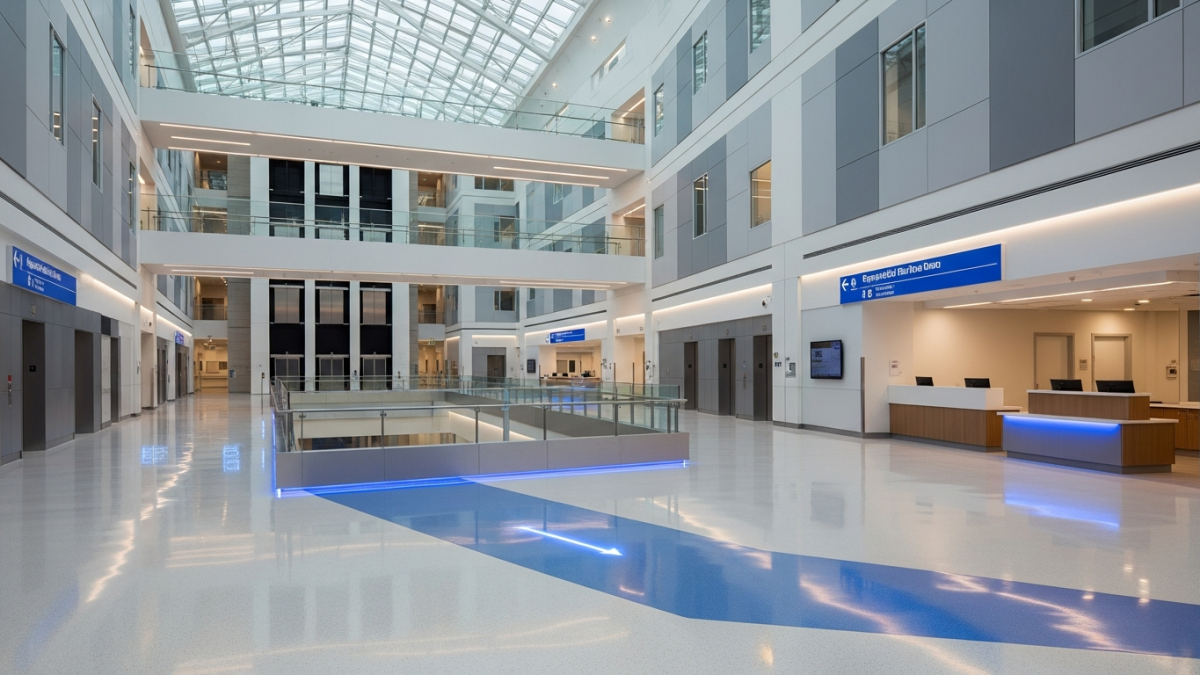
Before patients use a portal or meet a clinician, they encounter the campus. They park, choose an entrance, look for elevators, navigate registration, and try to interpret long corridors and building names.
When that sequence fails, the effects spread quickly. Call centers absorb more traffic. Front desks answer repetitive questions. Appointments start late. Clinicians and staff improvise around preventable delays. The issue isn’t inconvenience alone; it’s lost throughput.
Wayfinding connects silos without reorganizing the hospital
Most hospitals can’t quickly undo decades of fragmented growth. Departments remain spread across buildings, and service lines often operate with different systems and naming conventions.
What they can do is create a shared location truth: a reliable digital model of destinations, routes, entrances, temporary closures, and appointment endpoints. Done well, smart hospital wayfinding becomes a practical integration layer across facilities, access, ambulatory operations, and clinical services.
FAQ: What is the first step in hospital digital transformation?
Q: What is the first step in hospital digital transformation?
A: The first step is digital wayfinding. It reduces navigation friction, helps patients arrive at the right place on time, stabilizes frontline workflows, and gives hospitals a trusted location layer that supports scheduling, coordination, and other digital systems across the campus.
Why AI works better when the location layer is reliable
Health systems are moving quickly on AI for documentation, coding, inbox management, and scheduling. Those tools can reduce administrative load, but their value depends on the hospital’s ability to execute in the physical world.
That is where wayfinding becomes foundational. It improves the quality of operational assumptions: where a patient needs to go, how long a route takes, which entrance makes sense, and when late arrival should trigger a workflow change.
AI doesn’t fix weak physical coordination. It performs better when the hospital can trust its own movement and location data.
Hospital-at-home changes navigation; it doesn’t remove it
Hospital-at-home and remote monitoring shift some care beyond the inpatient tower, but they do not simplify access. They create a hybrid model in which patients still come to campus for imaging, infusion, specialist visits, procedures, or escalation.
That changes the meaning of wayfinding. It no longer starts at the front door. It begins before arrival, with clear instructions on where to enter, where to check in, where to park, and how to minimize unnecessary walking for higher-risk patients and families.
In that sense, navigation becomes arrival orchestration. The hospital experience depends as much on getting patients to the right place efficiently as on what happens once they are there.
What a hospital location layer looks like in practice
Some health systems already treat wayfinding as the first durable layer they can build on. In several deployments, Venux has been used first for digital wayfinding, then extended to asset tracking, and later to analytics that reveal movement bottlenecks and utilization patterns.
The important point is the sequence. A location-aware wayfinding system forces an organization to standardize named places, entrances, service points, and routes. Once that location graph exists, tracking no longer means simply finding a missing pump. It becomes a way to understand how equipment, staff, and patients move through the care environment.
Examples cited by Venux, including JHAH and NMC, suggest that hospitals can stage this approach without waiting for a multi-year rebuild. That matters for executives looking for infrastructure they can use now, not after a full campus overhaul.
Why starting with navigation unlocks the rest
If leaders are asking what the future hospital experience should look like, Mayo’s 2030 framing offers a grounded answer: coordinated, not flashy. Patients spend less time relocating. Staff spend less time giving directions. Care teams operate with fewer avoidable interruptions.
For organizations deciding where hospital digital transformation should begin, wayfinding stands out because it improves patient access, operational flow, and system integration at the same time. It also offers a clear test: does it reduce late arrivals, misdirected foot traffic, and disruption to frontline teams?
Hospitals will not reach 2030 by stacking disconnected pilots. They will get there by building a dependable digital foundation, starting with the simplest promise a complex campus can make: you can find your way here. For health systems evaluating that first layer, Venux is one example of how to start with wayfinding and build from there.
Leave a comment