
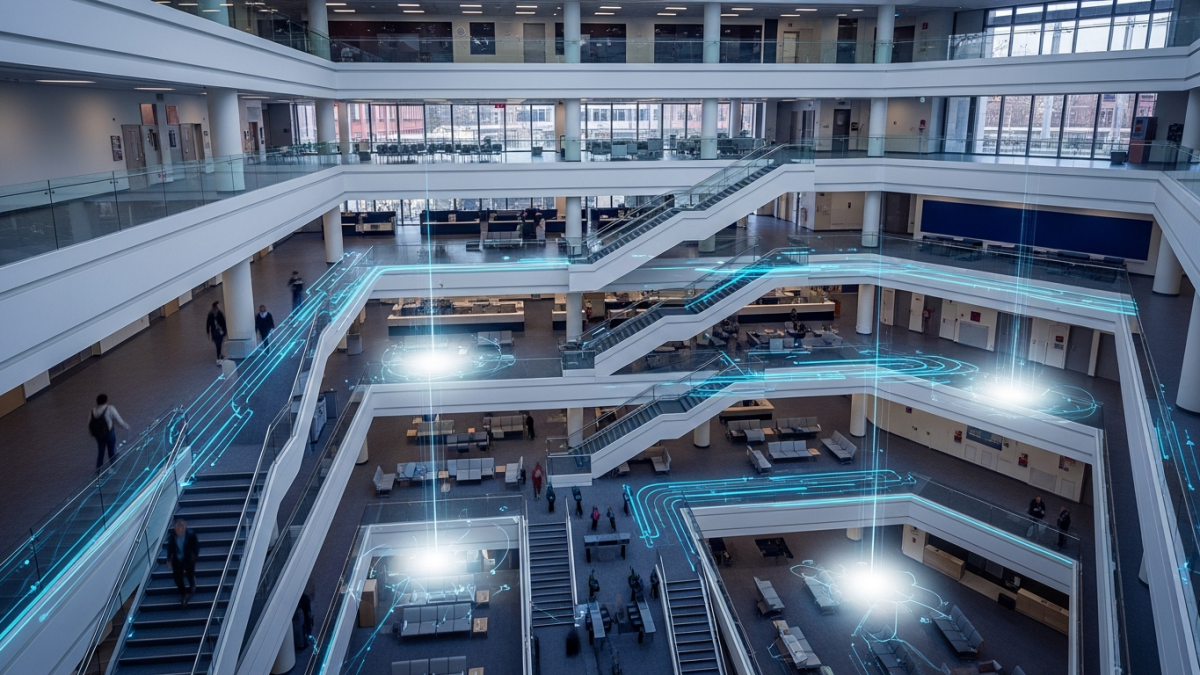
Indoor Intelligence Is Smart Cities’ Missing Layer
Smart cities can count vehicles at an intersection in real time, yet many still cannot answer a simpler question: how many people are in the hospital lobby right now? That blind spot keeps many AI programs stuck in pilot mode.
The problem is no longer theoretical. Around events such as the IDC Smart Cities Awards in March 2026 and Convergence India Expo in April 2026, the same pattern keeps surfacing: pilots demo well, dashboards impress stakeholders, and deployments stall when city leaders ask for operational proof across buildings, departments, and service hours.
For chief data officers and smart city program managers, the constraint often is not model sophistication. It is the lack of clean, real-time indoor intelligence that can be governed, compared, and acted on consistently.
Why outdoor data is not enough for a smart city
Cities have spent years instrumenting streets and public infrastructure: traffic flows, air quality, transit telemetry, curb usage, and public safety video. But many civic outcomes depend on what happens inside buildings, not outside them.
Healthcare throughput, permitting efficiency, emergency coordination, and public service delivery all hinge on indoor conditions. Since people spend roughly 90% of their time indoors, AI strategies built mainly on outdoor signals try to optimize the city with only part of the map.
That gap explains why indoor intelligence now appears more often in procurement language. City leaders want the missing layer that connects mobility to facilities, services to queues, and capital planning to actual space utilization.
Why smart city AI pilots fail to scale
Featured snippet: Why do smart city AI pilots fail to scale?
Why do smart city AI pilots fail to scale? Because they lack clean, real-time indoor data. Without reliable occupancy, movement, and location signals from buildings, AI models cannot be validated against actual service conditions, making it hard to move from a promising demo to repeatable citywide operations.
Many AI pilots fail for a simple reason: the inputs are weak. A model can classify, predict, or optimize only if the underlying data reflects real conditions on the ground.
JLL has repeatedly made this point in enterprise settings: data readiness matters more than AI capability. For cities, that means even well-funded analytics programs become fragile when buildings still rely on manual reporting, inconsistent sensors, or disconnected systems for occupancy and flow data.
The core metrics of indoor intelligence
The starting point for AI indoor positioning and indoor analytics is not exotic. It is operational. Three metrics do most of the heavy lifting: occupancy, flow, and dwell time.
Occupancy shows how many people are in a space, where they are, and when conditions change. Flow reveals how people move between zones. Dwell time shows how long they wait, pause, or remain in place.
Those measurements map directly to service KPIs: bottlenecks in clinics, overcrowding in permitting halls, underused public facilities, or evacuation decisions that require live headcounts rather than estimates from floor wardens.
They also create something cities often lack: comparability. Consultants and public-sector architects can use the same schema across libraries, hospitals, transit hubs, and municipal offices instead of redesigning the data model for every site.
From sensing to action, with an audit trail
Smart building indoor analytics become useful when they close the loop between sensing, interpretation, and action. Otherwise, they remain another dashboard no one uses.
Indoor intelligence should inform facility operations, security, visitor experience, and asset management. That can mean adjusting staffing based on actual footfall, changing cleaning routes based on usage, triggering alerts when crowd thresholds are breached, predicting queues, rerouting visitors through digital wayfinding, or locating critical equipment in real time.
For the public sector, another requirement matters just as much: auditability. If an AI recommendation changes staffing, access, or visitor routing, procurement teams, risk officers, and labor stakeholders need a clear data trail they can inspect and challenge.
How indoor intelligence scales across city operations
This is where many pilots break. A deployment works in one building, then falters when a city tries to extend it across departments, facilities, and governance structures.
The scalable model treats indoor intelligence as shared civic infrastructure, with privacy controls, standard APIs, and common governance. In practice, it plays a role similar to GIS in outdoor planning: a foundational layer that other systems can build on.
That is the more instructive way to view platforms such as Veenux. The value is not a dashboard alone. It is the ability to normalize real-time occupancy, visitor flow, and asset-location data across multiple venues so city teams can compare patterns, benchmark operations, and support AI applications without months of custom integration at every site.
The real bottleneck is not AI, but indoor truth
Smart city leaders do not need another round of pilots that prove AI can classify, predict, or optimize under controlled conditions. They need reliable indoor intelligence that lets those models face operational reality inside buildings, across facilities, and over time.
When cities close the indoor data gap, AI stops being a promising overlay and starts becoming an accountable operating layer. For teams evaluating that foundation, Veenux is one example of how to make indoor data usable at production scale.
Leave a comment