
QR Code Wayfinding in 2026: Why the Simplest Tech Is Winning
The most effective wayfinding technology in many buildings costs less than a dollar to deploy. It is the humble QR code—and in 2026, it often beats custom apps on the metric that matters most: use.
Venue teams keep hitting the same constraint: app fatigue. Most visitors will not download a venue app for a single visit, and “just use the kiosk” breaks down under real conditions—queues, dead screens, and accessibility barriers. At the same time, research and industry work on IoT-enabled wayfinding continue to point toward lighter, web-native models.
That makes QR code wayfinding less a throwback than an operationally sound choice.
Why venue apps keep losing the first interaction
Many facilities still default to native apps because they promise control. But that control comes at a price. Once mapping UX, analytics, device testing, and ongoing OS support are included, native wayfinding apps often cost $50K–$200K to build and maintain.
The bigger problem is adoption. Industry benchmarks commonly place venue app download rates below 5%, which makes the model hard to justify in airports, hospitals, campuses, and event venues where a large share of visitors are first-timers. Even strong physical signage struggles against the convenience of a phone-first experience: one ScienceDirect-cited finding reported that 94% preferred digital guidance over signage.
QR code wayfinding removes the biggest source of friction
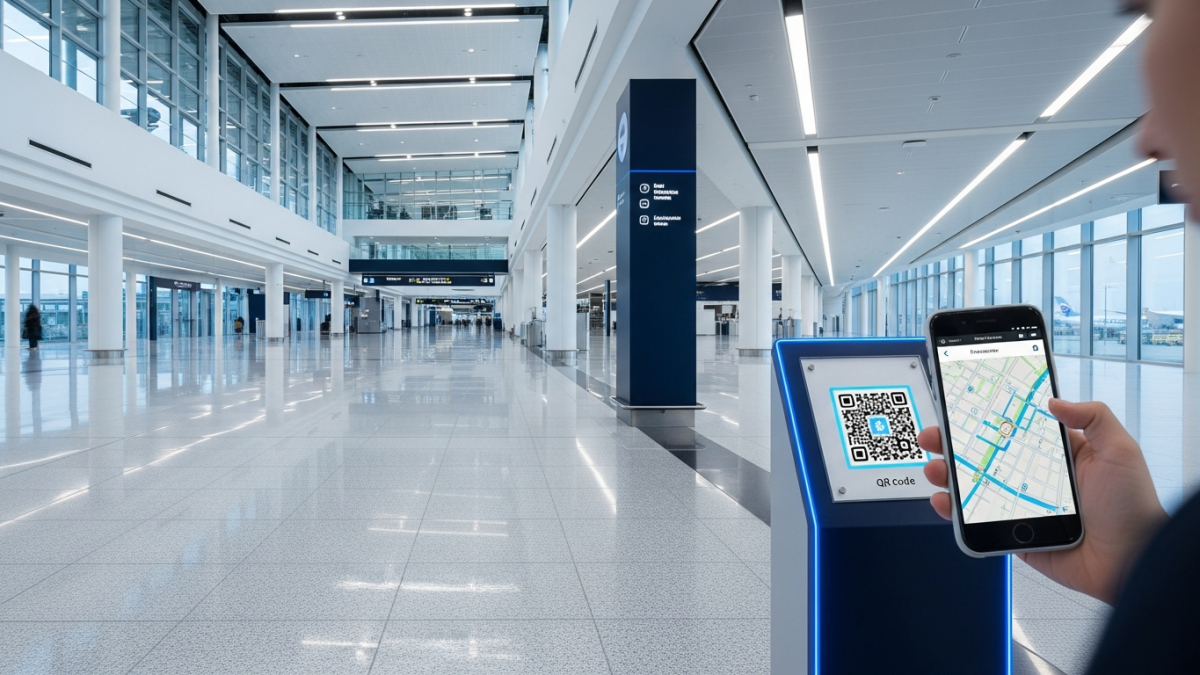
The better move is not to add another app. It is to remove steps. With QR code wayfinding, a visitor scans a code, opens a link, and lands directly on a browser-based indoor map. No app store. No login. No staff intervention.
In practice, that can shrink the path from confusion to orientation to a matter of seconds. That matters most at decision points—building entrances, elevator lobbies, corridor intersections—where hesitation compounds into congestion and more requests for help.
Featured snippet: Can QR codes replace wayfinding apps?
Q: Can QR codes replace wayfinding apps?
A: Yes. QR codes can open a browser-based indoor map or PWA instantly, giving visitors turn-by-turn directions without downloading an app. For most venues, that covers the core navigation need while reducing friction, support overhead, and app-store abandonment.
PWA wayfinding works because it behaves like an app without the app
A PWA wayfinding solution delivers much of the app experience through the browser. After the initial load, cached assets can keep maps available offline or in low-signal interiors—useful in basements, concourses, radiology departments, and service corridors where connectivity often drops.
PWAs also simplify multilingual support and accessibility improvements. Teams can update content server-side and publish changes immediately, rather than waiting for users to install the latest version or navigate platform-specific bugs.
Zero-download indoor maps fit how people already move through buildings
Operations leaders do not need more digital surfaces. They need fewer failure points. Zero-download indoor maps for visitors work because they fit existing behavior: people already reach for their phones when they are lost.
That makes the model portable across venues—hospitals, convention centers, museums, stadiums, and corporate campuses. Place QR codes at key nodes, connect them to a map that opens in the browser, and the system scales without assuming repeat visits or prior setup.
That logic also explains the appeal of products such as Veenux Shared Map, which uses a QR-deployed, browser-based indoor mapping approach. The model aligns with how visitors navigate in practice: quickly, on their own devices, and with little patience for friction.
The winner is not the flashiest system. It is the one people will use.
Wayfinding does not fail because buildings lack technology. It fails at the moment a visitor decides the technology is not worth the effort. In 2026, the strongest systems are removing that moment—eliminating the download, shortening the path to the map, and reducing dependence on staffed support.
QR code wayfinding is winning for a simple reason: it meets visitors where they already are. To see how that model works in practice, visit veenux.com.
Leave a comment