
QR Code Campus Maps Are Replacing Orientation Volunteers — and Reducing First-Week Anxiety
It’s 8:02 a.m. on your first Monday of college. Class started two minutes ago. You still don’t know where Building C, Room 204 is, and your phone is now less a convenience than a lifeline.
Multiply that moment by thousands of first-years, transfer students, and campus visitors, and confusion stops being a personal inconvenience. It becomes an operational problem. As universities face growing pressure to improve student experience in measurable ways, one of the most basic tests is also one of the most visible: can people find where they need to go, on time?
For student affairs leaders and facilities teams, the first week exposes how quickly small friction turns into missed classes, crowded help desks, and avoidable stress. That burden falls hardest on students who are new to the environment, navigating in a second language, or reluctant to stop strangers for directions.
Orientation Week Exposes the Limits of Analog Navigation
Most campuses still rely on volunteers, printed maps, temporary signs, and information desks. Those tools help, but only until demand spikes. Once a line forms, every question becomes a delay, and every delay compounds the next one.
That model also assumes students are comfortable asking for help. Many are not. International students may hesitate because of language barriers. Others may avoid asking altogether, especially in the first days of campus life when uncertainty is already high.
Digital wayfinding is becoming the expected alternative. PwC has reported that 78% of Gen Z prefer digital wayfinding. On campus, that preference matters because findability affects more than convenience. It shapes attendance, punctuality, confidence, and even how students perceive institutional support.
Why QR Code Campus Maps Work Better in Week One
No app, no login, no delay
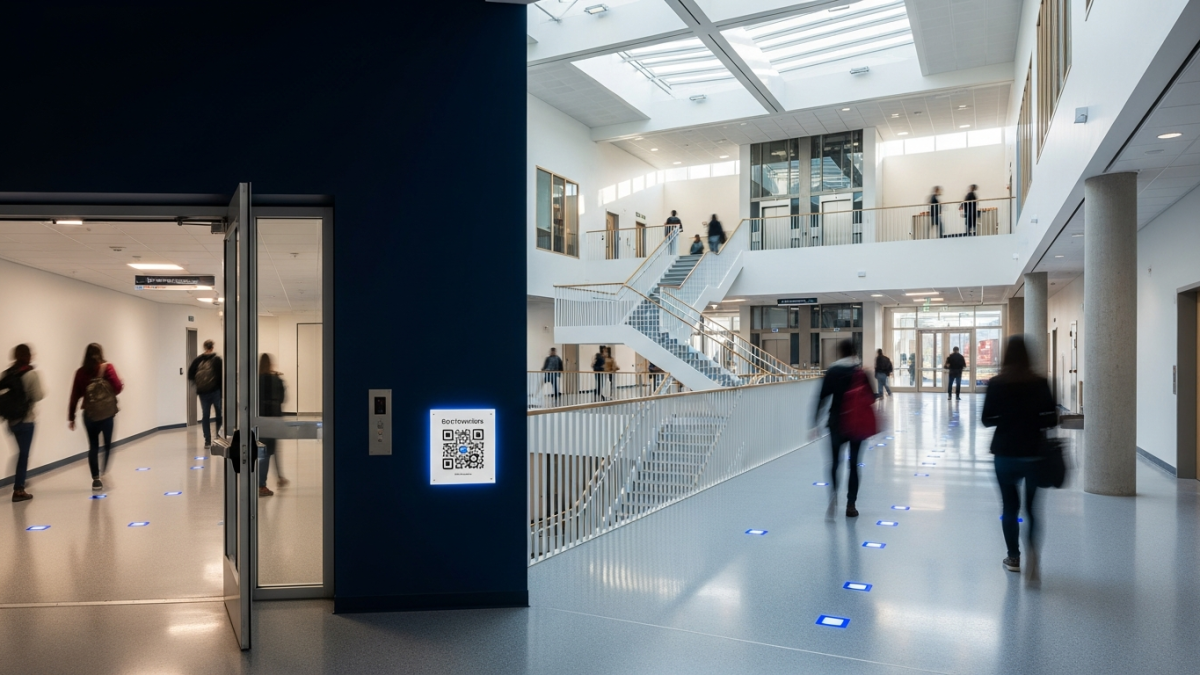
The most practical fix is often the simplest: a QR code campus map placed at shuttle stops, residence halls, and building entrances. A student scans the code, a browser opens, and an indoor route appears instantly.
That browser-based approach matters. Requiring an app download adds friction at the exact moment campuses need speed. Logins, app-store access, storage limits, and setup steps all create drop-off during new student orientation navigation. A no-download path removes those barriers.
FAQ
How can universities help lost new students navigate campus? Universities can place QR codes on posters, handouts, and entry points that open browser-based indoor maps. Students get instant turn-by-turn directions, often with multilingual and accessible routing, without downloading an app. That reduces pressure on orientation staff and helps students reach classrooms and services on time.
QR Code Campus Maps Need Multilingual and Accessible Routing
The real test of a wayfinding system is not whether it works for confident, English-speaking students with no mobility constraints. It’s whether it works for everyone in the first week, when uncertainty is highest and campus traffic is least forgiving.
That makes multilingual support and accessibility routing essential, not optional. International students benefit from interfaces in familiar languages. Wheelchair users and others with mobility needs need routes that prioritize elevators, ramps, and step-free entrances. Static PDFs and printed maps rarely handle that level of specificity well.
What Campus Deployment Looks Like in Practice
Some universities already treat browser-based indoor navigation as campus infrastructure rather than a temporary orientation tool. That shift matters because the same navigation problems do not disappear after week one. Students still need to find advising offices, labs, student services, and event spaces throughout the year.
Venux’s Shared Map is one example of that model. Students scan a QR code and open indoor directions in a browser, with no app and no login. The system also supports multilingual experiences, including Arabic and English, and is already in use at universities in Saudi Arabia, where large facilities and language diversity make first-week wayfinding a recurring challenge.
When Students Find Their Way, Staff Can Do Higher-Value Work
When campuses replace repetitive directional questions with reliable digital navigation, queues shrink and staff time shifts to issues that need human judgment: accommodations, advising, safeguarding, and triage.
That is the deeper operational value of QR code campus maps. They do more than help students reach a classroom. They reduce avoidable friction at scale and make the first week feel less chaotic for everyone involved.
For universities asking how to help new students find classrooms faster, the answer is no longer more volunteers alone. It is better wayfinding infrastructure.
Explore how Venux supports browser-based indoor wayfinding for campuses at veenux.com.
Leave a comment