
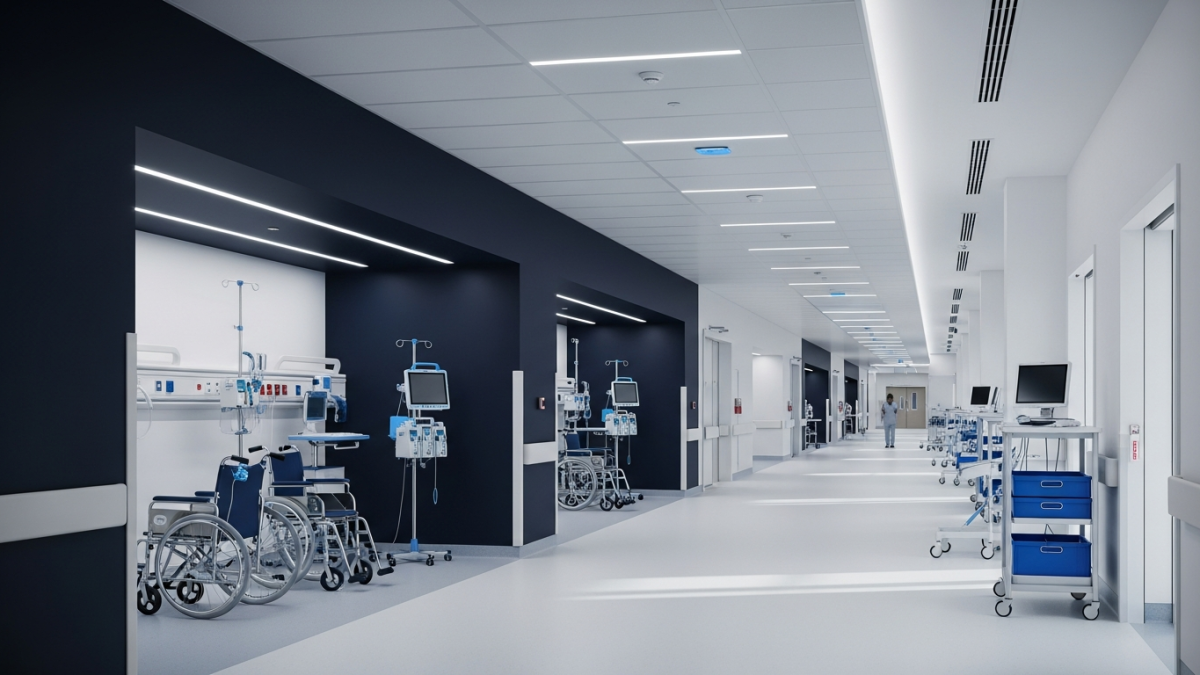
Hospital Asset Tracking: How BLE Tags Are Saving Millions in Lost Equipment
A nurse spends 20 minutes hunting for an infusion pump. Five sit idle in a closet two floors away. The hospital buys more equipment to solve a visibility problem that often costs less than the tag needed to fix it.
That mismatch—scarcity on the floor, surplus in storage—drives lost time, delayed care, and unnecessary capital spend. Nurses can lose 30 or more minutes per shift searching for mobile devices. Departments hoard equipment because they don’t trust it will be available when needed. And one “missing” asset can trigger a replacement cost of $4,000 or more.
The timing matters. Research & Markets projects the indoor location market will reach $21.46 billion by 2026 at a 23.6% CAGR. IEEE has pointed to 28% growth in UWB adoption, while Zebra reports more than 1.5 million RTLS tags deployed, with roughly 60% used in healthcare and logistics. For facilities and biomed teams, the question is no longer whether RTLS works. It is where simpler, lower-cost systems can deliver measurable returns.
How hospital asset tracking with BLE works
Hospital asset tracking with BLE starts with battery-powered tags attached to infusion pumps, wheelchairs, vital signs monitors, and other mobile equipment. Each tag broadcasts an identifier over Bluetooth Low Energy.
A network of receivers—using gateways, existing Wi-Fi infrastructure, or dedicated sensors—captures those signals and translates them into room- or zone-level locations. Software then places the asset on a floor plan, giving staff a practical form of indoor positioning for medical devices without requiring barcode scans or manual check-ins.
The value is operational, not theoretical. Staff do not need centimeter-level precision to find a pump. They need to know whether it is in the ICU, a nearby closet, or sitting idle on another floor.
FAQ: How do hospitals track equipment indoors?
Q: How do hospitals track equipment indoors?
A: Hospitals use BLE tags attached to mobile assets such as pumps, wheelchairs, and monitors. Receivers capture those signals and display the equipment’s room- or zone-level location on a dashboard, helping staff find devices faster, reduce search time, and avoid unnecessary replacement purchases.
Hospital asset tracking with BLE vs UWB
Both BLE and UWB support RTLS for healthcare equipment, but they solve different problems.
BLE fits broad hospital coverage. Tags cost less, batteries last longer, and deployments usually require less infrastructure. The tradeoff is accuracy. BLE typically delivers room- or zone-level location depending on sensor density and RF conditions. Elevators, lead-lined rooms, and dense equipment can all interfere with signals.
UWB delivers far greater precision, often at sub-meter level. That extra accuracy matters in higher-risk workflows, such as tracking critical devices in emergency, interventional, or perioperative areas. The tradeoff is cost, complexity, and infrastructure overhead—factors that become harder to justify when a hospital wants to track thousands of mixed-value assets.
That is why many hospitals split the problem in two: use BLE for the broad fleet of mobile assets, and reserve UWB for the smaller set of devices or spaces where pinpoint location changes the workflow.
Where the ROI comes from
For most hospitals, the ROI case for hospital asset tracking comes from three levers.
1) Less time spent searching. If nursing teams recover even 10 to 20 minutes per shift across multiple units, the labor value adds up quickly. A low-cost BLE tag often pays for itself by solving the simple but persistent question: where is the device right now?
2) Better utilization and less hoarding. When departments can see what is available on a live map, they are less likely to hold extra equipment “just in case.” That improves fleet sharing and often delays new purchases.
3) Fewer replacement purchases. A lost infusion pump or monitor can easily cost more than $4,000 to replace. In many cases, the asset was never lost at all. It was parked in the wrong room, left in a corridor, or stored under another department’s control. Location visibility turns replacement from a default reaction into a last resort.
The non-obvious gain is trust. Once staff believe the system can reliably show what is available and where, behavior changes. Hoarding drops. Shared pools become viable. Utilization improves because people stop planning around uncertainty.
What the dashboard must show—and why CMMS integration matters
The practical question behind how to track wheelchairs in a hospital with BLE is a software question: can staff find equipment in seconds rather than minutes?
An effective dashboard shows live location on floor plans, last-seen timestamps, and simple filters by asset type, unit, or status. The interface must reduce friction. If the map is slow, cluttered, or hard to search, staff will revert to asking colleagues and walking the halls.
For facilities and biomed teams, the bigger payoff comes when location data connects to the CMMS. That allows teams to confirm whether an asset has been found, route maintenance based on proximity, and tie service records to the actual device rather than a guessed serial number or stale spreadsheet entry.
For example, Venux Asset Tracking uses a BLE dashboard to display tagged mobile assets on live floor plans and support multi-site visibility. In healthcare environments where equipment moves constantly across units and departments, that cross-site view addresses one of the hardest operational problems: shared assets without shared visibility.
Privacy and governance: track assets, not staff
Asset tracking programs often fail for reasons that have nothing to do with technology. If staff think the system monitors people rather than equipment, adoption slows and workarounds follow.
The safer model is straightforward: tag assets, not badges; limit access by role; keep granular history only as long as operations require it; and document the purpose clearly. The goal is equipment availability and patient flow—not performance monitoring.
That governance model protects trust, which in turn protects data quality. Once teams start removing tags or ignoring the system, even the best infrastructure stops producing useful location data.
Where to start
The strongest deployments start with the assets that move most, disappear most often, and get shared across the most teams. That usually means pumps, wheelchairs, monitors, and other mobile devices that regularly create friction between units.
From there, hospitals can expand coverage with clear expectations about accuracy: BLE for room or zone visibility, UWB for workflows that demand precision. The financial return rarely appears as one dramatic savings line. It shows up in fewer wasted minutes, fewer unnecessary rentals, fewer duplicate purchases, and better use of the equipment already on site.
For teams evaluating options, exploring Venux’s approach to healthcare asset tracking offers a practical view of how a BLE-first deployment can work in real facilities.
Leave a comment