
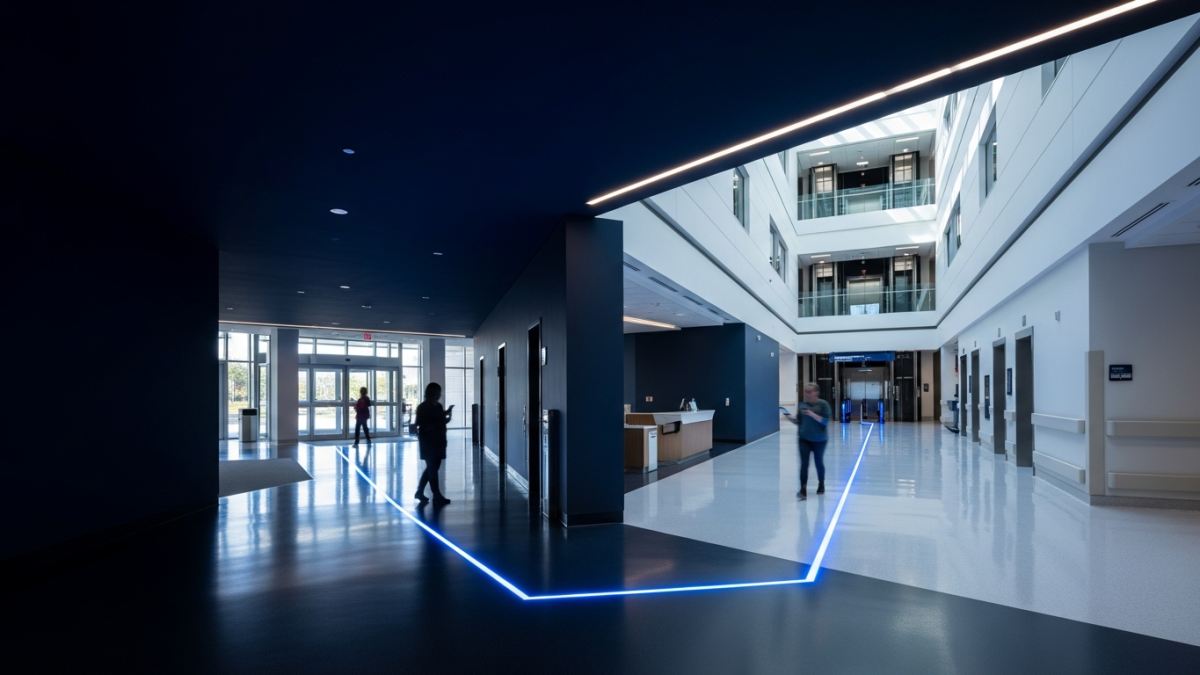
Hospital Wayfinding Is a Patient Safety Metric, Not a Convenience
A visitor arrives at a hospital already anxious about a loved one. Ten minutes later, they are lost, late, and more stressed than when they walked in. That moment may look like a signage issue. In practice, it shapes patient experience, strains operations, and introduces avoidable safety risk.
Recent research on IoT-enabled wayfinding, including a widely cited 2025 ScienceDirect study, points to the same conclusion echoed in newer clinical-operations thinking in Frontiers in Medical Technology: navigation friction is measurable. It can be reduced, managed, and tied to outcomes executives already care about. That makes hospital wayfinding part of patient safety and quality performance, not a cosmetic facilities upgrade.
Why hospital wayfinding belongs in quality and safety discussions
Hospitals already track proxies that reveal the real experience of care: time-to-triage, falls, readmissions, and call-light response. Hospital wayfinding deserves similar attention. When patients and families spend the first part of a visit searching for the right building, entrance, or department, delays spread quickly.
Late arrivals disrupt imaging schedules, congest lobbies, force rushed check-ins, and pull frontline staff away from clinical work to give directions. What starts as confusion at the curb often ends as friction across the visit.
The safety implications are easy to underestimate. Stress narrows attention and weakens comprehension. That matters when people need to follow instructions about medication changes, consent, discharge, or next steps in care. Hospital wayfinding patient safety is not an abstract concept; it is about reducing preventable errors created by disorientation.
What digital wayfinding data shows in hospitals
The 2025 ScienceDirect IoT wayfinding study offers something patient-experience debates rarely get: hard usability data. Reported outcomes were striking. 85% found the system easy to use, 87% said it reduced navigation time, 94% preferred digital wayfinding over signage, and 100% said they would recommend it.
Those numbers matter because they shift the conversation from opinion to operations. If most users navigate faster and prefer digital guidance to static signs, then wayfinding is no longer just an environmental design issue. It becomes a controllable variable in access, flow, and satisfaction.
The same logic appears in Frontiers in Medical Technology, which argues that indoor navigation should be treated as part of the hospital’s socio-technical safety system rather than a standalone app. That framing is useful. Hospitals do not run on signs alone; they run on systems that help people move, decide, and act under stress.
FAQ: Does hospital wayfinding affect HCAHPS scores?
Yes. Hospital wayfinding affects satisfaction because navigation problems raise stress, delay arrivals, and worsen first impressions. In recent research, 94% preferred digital wayfinding to signage and 87% said it reduced navigation time. Those gains can influence experience measures that often surface in HCAHPS feedback and patient comments.
Why static signage often fails in complex care environments
Hospitals change constantly. Clinics move, names change, wings expand, and temporary routes become permanent. Static signage struggles to keep up. Even when signs are technically correct, they still compete with cognitive overload, unfamiliar terminology, language barriers, and the sheer scale of large campuses.
That is why adding more signs often produces diminishing returns. More information does not always create more clarity. Digital navigation for hospital visitors works differently: it updates centrally, responds to live destinations, and guides each person along the route they need at that moment.
SMS-based, bilingual guidance removes friction at the point of need
Hospitals do not need to force every visitor to download an app to improve wayfinding. SMS-based navigation is a practical design choice because it works on nearly any phone and starts immediately. A hospital can trigger it through appointment reminders, QR codes at entrances, or links in pre-visit instructions.
That low-friction model matters because adoption is often the hidden failure point in digital tools. The best route guidance delivers little value if users must first install software, create an account, or learn a new interface while under pressure.
Language support matters just as much. Multilingual, turn-by-turn guidance is not a convenience feature; it improves comprehension and throughput. It reduces reliance on improvised interpretation at information desks and lowers the burden on nursing units that should not operate as backup concierge teams.
For leaders asking how to improve HCAHPS with digital maps, this is one of the clearest mechanisms: fewer confused arrivals, fewer tense interactions, and fewer late starts that shape the entire visit before care even begins.
Parking is often the first wayfinding failure point
Wayfinding problems usually start before anyone reaches the lobby. Visitors circle lots, choose a spot that seems close enough, and later struggle to remember where they parked. When 35% forget their parking location, stress follows them into the building and often returns on the way out.
That matters more than it seems. Families leaving an appointment may be processing discharge instructions, test results, or bad news. A frustrating search for the car is not separate from the care experience; it is part of it.
Strong digital wayfinding treats parking as part of the journey: where to park, which zone to remember, which entrance best matches the destination, and which route is accessible. That reduces late arrivals and keeps staff from becoming the hospital’s default navigation layer.
What scaled deployment looks like in practice
Some hospitals have already moved beyond pilot programs. In the GCC, indoor navigation platforms now support routine patient and visitor movement at scale. Venux, for example, has been deployed in environments including Johns Hopkins Aramco Healthcare and NMC Healthcare, using SMS-triggered indoor navigation to guide people from parking to the appointment room with multilingual maps.
The broader lesson is not vendor-specific. Adoption improves when navigation tools meet people where they already are: on their phones, in their language, and with directions tied to an exact destination rather than a generic building map.
What hospitals should measure next
If hospital wayfinding is going to be managed like a quality program, it needs operational metrics. Start with indicators leadership already recognizes: late-arrival rates, appointment reschedules, lobby congestion, interpreter use for non-clinical questions, and the volume of calls or desk interactions that are simply requests for directions.
Then connect those signals to survey comments and patient-experience data. If the question is whether hospital wayfinding affects patient satisfaction scores, the answer will usually appear in the correlation between early navigation failures and complaint patterns, abandoned visits, or negative comments about the visit before care even began.
Hospitals cannot remove the anxiety that patients and families bring with them. They can remove avoidable confusion. That makes wayfinding one of the few experience variables that is both high-impact and fixable—with consequences for safety, throughput, and trust.
To explore how digital wayfinding fits into hospital operations, visit veenux.com.
Leave a comment