
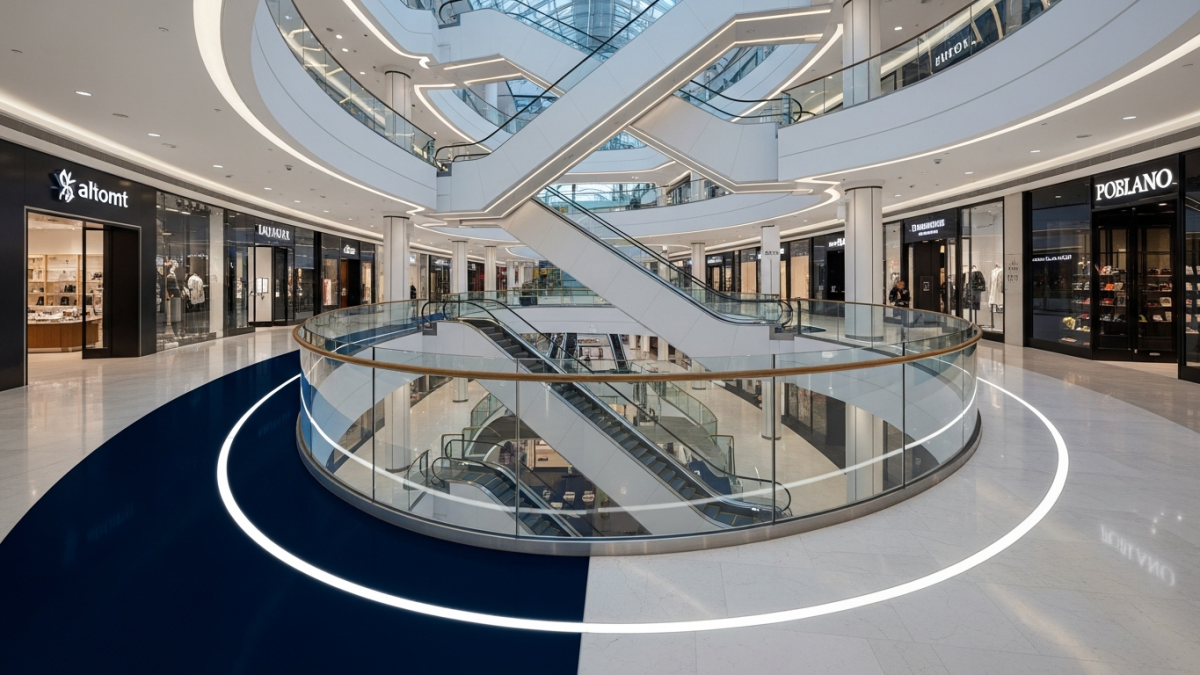
Phygital Retail: How Indoor Maps Are Turning Malls Into Discovery Engines
The mall isn’t dying. It’s competing on a different battlefield: convenience, relevance, and the quality of the visit itself.
E-commerce has trained shoppers to expect low-friction discovery. Inflation has made discretionary trips harder to justify. At the same time, many mall operators still lack clear visibility into visitor flows, dwell time, and tenant-level performance. Across recent retail trend coverage, one conclusion keeps surfacing: the mall’s real advantage is no longer tenancy alone. It is orchestrated experience.
For investors and mall marketing teams, that changes the mandate. Phygital retail is no longer about adding more screens. It is about building systems that explain what happens between entry and purchase—and help shape what happens next.
Phygital retail is becoming the baseline for mall relevance
Featured-snippet answer: What is phygital retail in malls?
Phygital retail in malls blends the physical shopping environment with digital tools such as indoor maps, foot traffic analytics, AR experiences, and location-based promotions. The goal is to make visits easier, more relevant, and more engaging while giving operators better visibility into how people move, discover, and buy.
In practice, phygital retail reduces friction while increasing serendipity. A shopper finds the store they came for without wasting time, then discovers a restaurant, event, or offer that improves the trip. That is the core of a modern mall strategy: not simply connecting online and offline, but linking the on-site experience with digital guidance in real time.
Indoor maps turn a mall from directory into discovery engine
Static directories answer one question: where is the store? Indoor maps can answer a better one: what matters right now?
When operators treat indoor mapping as a live layer of the property rather than a digital poster, it becomes more useful. Visitors can see routes that avoid congestion, locate the nearest elevator during a stroller-heavy weekend, find a pop-up nearby, or choose a restaurant with a shorter wait. The map stops acting like signage and starts behaving more like search.
That shift matters because shoppers increasingly think in intent, not in store names. They search for “running shoes under $150,” “kid-friendly lunch,” or “closest return desk.” A strong indoor mapping system translates that intent into options, location context, and navigation. The mall no longer feels like a grid of units. It feels responsive.
Foot traffic analytics make tenant performance easier to explain—and defend
For property stakeholders, the most important questions are often the hardest to answer with confidence. Which entrances bring in high-value traffic? Which corridor underperforms because of layout rather than leasing? Which tenants attract visitors, and which benefit from adjacency?
Foot traffic analytics provide evidence where instinct often dominates. Operators can measure flows between anchors and specialty retail, compare dwell time by zone, and track repeat visitation patterns against campaigns, events, or seasonal shifts. That creates a stronger basis for tenant-mix decisions and a more credible story in leasing conversations.
This is where digital infrastructure spending is heading as well. Digital signage is projected to grow from $28.83B in 2026 to $45.94B by 2030, with malls accounting for roughly 27% of signage deployments. Screens matter, but the larger value often comes from integration. A screen network, indoor map, and analytics layer are more useful together than as separate projects with separate reporting.
Location-based promotions work better when timing replaces volume
Most mall promotions underperform for a simple reason: they ignore context. The same offer lands differently when it reaches a shopper near the right corridor, category, or decision point.
That is where phygital retail becomes operational rather than conceptual. If the system knows a visitor is on level two near athleisure, it can prioritize an offer that fits the moment or highlight an event nearby that extends dwell time. The goal is not message volume. It is relevance.
Handled well, location-aware promotion reduces decision fatigue. It helps shoppers act on intent while creating more conversion opportunities for tenants. For operators, the benefit is equally practical: campaigns become easier to measure because exposure, movement, and response can be evaluated in the same environment.
AR works best when it is tied to place, not novelty
The standard for a “worth the trip” visit keeps rising, especially for families and destination shoppers. Experiences that combine navigation, storytelling, and interaction increasingly shape that judgment.
Retail tech research often cited in planning shows that AR users can be 84% more engaged, while 61% say they prefer brands that offer AR. In malls, that potential is strongest when AR connects to the physical setting: scavenger hunts that move visitors through underused zones, product trails that guide traffic to tenants, or interactive exhibits that turn common areas into programmed destinations.
AR by itself will not fix a weak tenant mix. Paired with mapping and analytics, however, it becomes measurable. Operators can test whether an experience redistributed traffic, increased dwell time, or lifted cross-shopping between categories. That is a more useful standard than novelty alone.
A practical architecture: wayfinding, analytics, and promotions on one layer
Many operators still manage digital wayfinding, indoor analytics, and campaign tools through separate vendors. That fragmentation creates reporting gaps and weakens the usefulness of each system.
A more durable model brings those capabilities onto a shared digital layer. Shoppers get interactive maps and navigation. Operators gain clearer visibility into movement patterns, tenant-level signals, and campaign effects. The important point is architectural, not promotional: indoor mapping works better when measurement and activation draw from the same source of truth.
Veenux reflects that integrated approach, combining digital wayfinding, indoor intelligence, and location-aware engagement in a single platform. For mall teams evaluating the category, it offers a useful reference for how a combined stack can work in practice.
What mall operators and investors should watch next
The next phase of mall modernization will not be judged by whether a property has an app or digital screens. It will be judged by whether the mall can learn. Where does friction occur? Which experiences move people across zones? Which campaigns change behavior rather than just generate impressions?
That is why phygital retail matters. It gives operators a way to connect navigation, discovery, promotion, and measurement into one feedback loop. The winners will be the properties that treat the mall less like a static asset and more like a system that listens, adapts, and earns the trip.
For teams exploring that model, it is worth studying platforms and case studies through that lens. A useful starting point is veenux.com, which shows how wayfinding, analytics, and location-based engagement can work as one operational layer.
Leave a comment