Wayfinding

Biometric Boarding Is Just the Start, Airports Still Need to Fix Indoor Navigation

Airports have solved the identity problem with biometrics. But between the scanner and the gate, passengers are still wandering in circles.

The aviation industry entered 2026 on a high. Biometric boarding is scaling fast, digital travel credentials are going mainstream, and the ACI World–Amadeus Technology Innovation Awards just recognized a new generation of airports building fully contactless passenger journeys. Facial recognition now links a passenger’s identity to their boarding pass, bag tag, and lounge access in a single token — no paper needed.

But here’s the uncomfortable truth the biometric conversation keeps ignoring: verifying who a passenger is does not tell them where to go.

Q: After biometric check-in, what’s the biggest remaining airport friction? A: Navigation. According to Mappedin’s 2026 State of Venue Experience report, 53% of venue visitors still experience wayfinding problems. Biometrics verify identity — but they don’t tell you where Gate B47 is. Digital indoor maps close that gap.

Biometrics Solve Identity, Not Navigation

Single-token biometric journeys are impressive. A passenger walks through check-in, bag drop, security, lounge access, and boarding with their face as their only credential. The friction at each checkpoint drops dramatically.

But between those checkpoints, passengers are on their own. And the data suggests that’s a problem. Mappedin’s research, which surveyed nearly 500 venue visitors across North America, found that more than half encountered at least one navigation problem in the past six months — and that 77% of all visitors now actively use digital tools to find their way. Only 23% still rely solely on physical signage or staff assistance.

For airports investing millions in biometric infrastructure, ignoring the space between the scanners is a strategic blind spot.

The Gap Between Security and the Gate Is a Revenue Leak

Navigation friction doesn’t just frustrate passengers. It costs airports money.

Every minute a traveler spends searching for their gate is a minute they’re not browsing duty-free, ordering a meal, or discovering a lounge. Mappedin’s data reveals that 50% of venue visits are discovery-oriented — visitors arrive without a specific purchase in mind, open to browsing, dining, and exploring. If they can’t find what’s available, they won’t spend.

Airport retail and food-and-beverage concessions depend on passenger dwell time. When navigation fails, dwell time drops, and so does ancillary revenue — the income stream airports increasingly rely on to offset tight operational margins.

Digital Wayfinding: The Missing Layer

The airports leading the next phase of passenger experience aren’t just deploying biometrics. They’re layering digital wayfinding on top — connecting identity verification to real-time indoor navigation.

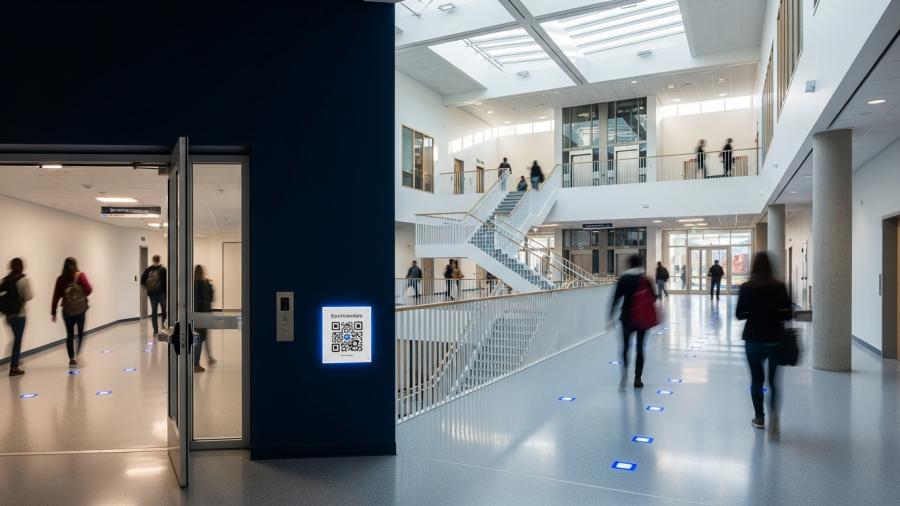
The most effective implementations share three characteristics. They are instant, requiring no app download and working through a simple QR code scan that opens an interactive map in the passenger’s browser. They are integrated, connecting wayfinding to digital signage, flight information systems, and retail discovery. And they are data-generating, capturing anonymized foot traffic and flow patterns that feed into operational planning and digital twin systems.

This approach turns wayfinding from a passive signage exercise into active infrastructure — the kind that reduces staff directional queries, increases retail visibility, and gives airport operators the indoor data they’ve been missing.

From Concept to Deployment

This isn’t theoretical. Airports across the GCC and beyond are already deploying QR-based indoor navigation that gives passengers turn-by-turn directions from any terminal touchpoint, with zero downloads and multilingual support.

It’s the kind of solution that fills the post-biometric gap — connecting the identity layer airports have invested in to the navigation layer passengers actually need.

The Bottom Line

Biometric boarding is a breakthrough. But breakthroughs create new expectations. Once a passenger breezes through security without touching a document, they expect the rest of the journey to be just as seamless.

The airports that win in 2026 won’t be the ones with the best scanners. They’ll be the ones where no passenger ever has to ask, “Which way to Gate B47?”

data-5

Wayfinding for Complex Venues

We have all been there. You step off a flight into a sprawling, unfamiliar terminal, your phone is on 4% battery, and your connecting gate is technically in a different zip code. Or perhaps you are standing in the lobby of a mega-hospital, clutching a referral slip, staring at a static wall directory that looks more like a circuit board than a map.

The resulting feeling is a mix of panic and frustration known as “spatial anxiety.”

For years, architects focused on the structural integrity and aesthetic grandeur of buildings. But today, the focus has shifted to the experience of the human inside the box. In complex venues—sprawling airports, multi-wing hospitals, labyrinthine malls, and resort-style hotels—the ability to navigate intuitively isn’t a luxury. It is the very foundation of the visitor experience.

When we talk about wayfinding, we aren’t just talking about signage. We are talking about the seamless intersection of psychology, design, and technology that helps us answer the two most primal questions we ask when entering a new space: Where am I? and How do I get to where I want to be?

The Psychology of Getting Lost

To understand why wayfinding matters, we first have to appreciate how stressful it is to be lost. When a visitor enters a complex venue, their brain is immediately tasked with building a “cognitive map.” In a small coffee shop, this takes seconds. In a 2-million-square-foot facility, it is impossible without help.

When navigation fails, cortisol levels spike. A frustrated visitor in a mall stops shopping and leaves. A confused traveler in an airport misses a flight. A stressed patient in a hospital arrives at their appointment in a state of agitation, complicating care.

Good wayfinding reduces this cognitive load. It acts as an invisible hand, guiding visitors so they can focus on why they are there—whether that’s to board a plane, buy a gift, or heal.

Moving Beyond the Static Sign

Historically, the solution to navigation was the placard. Arrows pointing left, right, and forward. While physical signage remains vital, the sheer complexity of modern venues has rendered static signs insufficient. They can’t update in real-time, they can’t speak your language, and they can’t guide you from a specific “You Are Here” point to a moving target.

This is where the interactive digital map has revolutionized the industry.

Imagine entering a massive convention center hotel. Instead of asking a busy concierge for directions to the keynote hall, you scan a QR code or approach a kiosk. You get a blue-dot navigation experience—similar to GPS for your car, but for the indoors. It’s friendly, it’s instant, and it empowers the user.

Digital wayfinding bridges the gap between the physical environment and the digital expectation. We live our lives on screens; expecting visitors to navigate complex physical spaces without digital aid feels increasingly archaic.

Context Matters: The Stakes of Navigation

While the technology is universal, the application differs wildly depending on the venue. The “why” changes the “how.”

1. Hospitals: Wayfinding as Empathy
In hospitals, visitors are often under high stress. They are worried about a loved one or their own health. Getting lost here isn’t just an inconvenience; it can feel traumatic. Effective wayfinding in healthcare is an act of empathy. It requires clear, reassuring cues and digital systems that account for mobility issues, ensuring the shortest, most accessible routes to elevators and clinics.

2. Airports: The Efficiency Engine
For airports, time is the currency. A lost passenger causes delays. The goal here is velocity and flow. Digital maps in airports are now integrating live data—showing not just where the gate is, but how long it takes to walk there, where the nearest restroom is along the path, and real-time flight updates. It turns a chaotic sprint into a managed journey.

3. Malls: The Discovery Tool
In malls, the goal isn’t just getting from A to B; it’s about discovery. Wayfinding here serves a dual purpose: utility and exploration. An interactive map can guide a shopper to a specific shoe store, but it can also highlight a coffee shop on the way or notify them of a pop-up event nearby. It transforms navigation into engagement.

The Future is Friendly

The beauty of modern wayfinding technology is that it doesn’t need to feel “high-tech.” It just needs to work. The best systems are the ones you barely notice because they feel so natural.

As venues continue to grow in size and complexity, the gap between a terrible experience and a delightful one will often come down to navigation. By prioritizing smart, friendly, and accessible wayfinding strategies, facility managers aren’t just managing traffic—they are curating confidence.

In the end, a visitor who knows where they are going is a visitor who is happy to be there.